

Reviewed by WPM Editorial Team · Last reviewed May 7, 2026
📚 Part of our complete paper manufacturing process and equipment overview. This guide focuses on India-specific cost; for global process and equipment, see the pillar.
🔑 Key Takeaways: Paper Manufacturing Plant Cost in India 2026
- Capex range: $0.4M to $15M+ (₹3cr to ₹125cr+) depending on capacity, from small recycled mill (5–10 TPD) to large integrated mill (300+ TPD)
- Per-tonne capex: Approximately $48,000 to $60,000 per TPD (₹40 to ₹50 lakh) across all capacity tiers
- Government schemes can offset 15–35% of project cost through PMEGP, EPCG, and state-level capital subsidies
- Break-even period: 3 to 5 years for mid-capacity mills, with stabilized post-payback ROI of 12–18% annually
- Largest cost component: Paper machine alone consumes 50–60% of total project budget
All figures are indicative ranges based on supplier-published reference projects and IPMA member benchmarks, as of May 2026. Confirm with verified suppliers and your project DPR (Detailed Project Report) before financial commitment.
Introduction
Setting up a paper manufacturing plant in India is one of the more capital-heavy industrial decisions a business can make. Real-world project cost ranges from around ₹3cr for a small recycled-paper mill to over ₹125cr for a large integrated facility, and the paper machine alone usually consumes 50 to 60 percent of the total budget.
India is the world's fastest-growing major paper market, producing roughly 22 to 25 million tonnes of paper and paperboard annually (per IPMA Statistics), with projected growth of 6 to 8 percent CAGR through 2030. Three demand drivers are doing the heavy lifting: FMCG and e-commerce packaging, the single-use plastic ban accelerating fiber-based packaging, and steady tissue consumption growth.
This guide focuses specifically on the India context, capex ranges in rupees, applicable government schemes, state-level site considerations, and regulatory checklist. For the broader global view of how a paper manufacturing line is built, what equipment goes where, and which markets dominate global production, see our complete paper manufacturing industry guide. For a buyer-focused machinery cost reference, the paper-making machine cost and price guide breaks down equipment pricing by capacity and grade.
How to Start a Paper Manufacturing Plant in India
Starting a paper mill in India follows a structured five-stage process. Each stage feeds into the next, and skipping steps leads to costly rework or regulatory rejection.
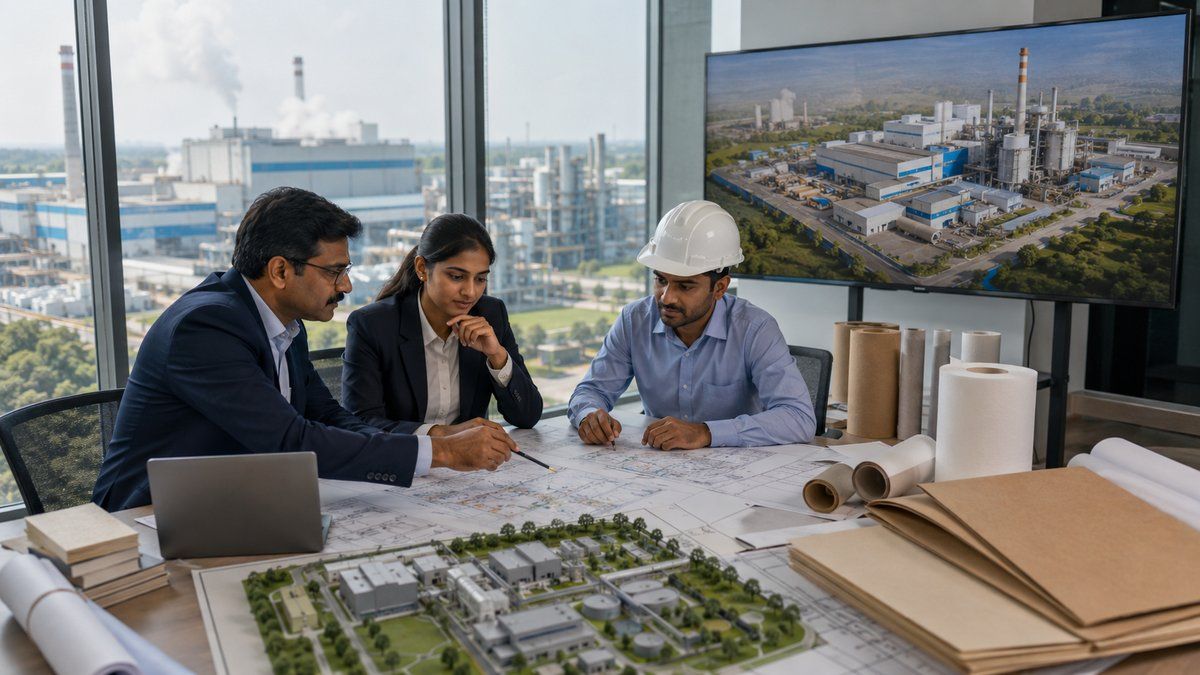
Step 1. Market and Feasibility Study
Identify your target paper grade (kraft, tissue, writing-printing, board, recycled). Match this to demand in your region, most successful Indian mills serve regional buyers within a 500 km radius. Estimate target capacity (5 to 300 tonnes per day) based on demand and budget.
Step 2. Capacity and Paper Grade Selection
Common entry points for new Indian mills:
- 5 to 10 TPD recycled writing or kraft paper (low capex, fast payback). See kraft paper manufacturing process and applications
- 20 to 50 TPD mid-scale kraft for packaging (best risk-reward)
- 50 to 100 TPD integrated mill with multi-grade flexibility (tissue, board, writing. See the tissue paper manufacturing process for grade-specific machinery requirements)
- 100+ TPD large mills (typically expansion projects, not greenfield)
Step 3. Site Selection
Critical site requirements: water availability (60 m³ minimum per tonne of paper), reliable grid power or captive cogeneration, proximity to raw material sourcing (waste paper hubs for recycled, biomass for non-wood), state pollution board approval timelines, and labor availability.
Step 4. Licensing and Regulatory Approvals
Begin CTE application with the State Pollution Control Board before machinery procurement. Factory License under the Factories Act, GST registration, MSME Udyam, and IEC (for imports) follow in parallel.
Step 5. Machinery Procurement and Installation
Order paper machine 6 to 12 months ahead of planned commissioning. Indian-made machines from manufacturers like Parason offer cost-efficient configurations for 5 to 100 TPD mills. Imported machinery for larger capacities involves additional 7.5 percent BCD plus IGST (per DGFT customs duty schedules), partially offset by EPCG scheme benefits.
Paper Manufacturing Plant Cost: Capex Breakdown by Capacity
Capital expenditure scales non-linearly with capacity. Larger mills offer better cost-per-tonne efficiency but require significantly higher absolute investment. The figures below are industry estimates based on supplier-published reference projects and IPMA member benchmarks.
Machine selection is one of the largest capex line items. Before finalising your supplier, compare the top paper machine manufacturers worldwide across capacity, equipment scope, and turnkey delivery options — the guide covers Indian, Chinese, and European OEMs side-by-side with pricing ranges in USD, INR, EUR, and CNY.
⚠️ Important note on cost figures: All cost ranges in this guide are indicative, not fixed prices. Actual project cost depends on multiple variables, installed capacity, paper grade, machinery sourcing (Indian-manufactured vs imported), automation level, plant location, land acquisition cost, raw material strategy, foreign-exchange rates at time of import, and current commodity prices. Always confirm exact figures with verified suppliers and your project Detailed Project Report (DPR).
Why per-tonne capex stabilizes around ₹40 to 50 lakh per TPD: paper machine cost dominates the total at all scales. Small mills get hit by minimum-feasible sizing of pulpers, ETPs, and boilers (overheads don't shrink linearly). Large mills gain efficiency through automation and continuous operation.
Cost ranges include machinery, building, utilities, ETP, working capital, licensing, and pre-operative expenses but exclude land cost (which varies dramatically by state. See Section 8).
Get a feasibility report customized to your target capacity →
Mini Paper Mill Project Cost in India (5 to 10 TPD)
A mini paper mill, typically 5 to 10 TPD of recycled paper output, is the most common entry point for first-time paper manufacturing investors in India. Total project cost ranges from ₹3 Cr to ₹8 Cr depending on automation level, machine origin (Indian vs imported), land acquisition strategy, and whether you start with recycled fiber or include a basic pulping line.
What ₹3 Cr to ₹8 Cr actually buys
Realistic expectations for a mini mill
- Production: 1,500 to 3,000 tonnes per year at 60 to 80 percent utilization
- Revenue at ₹45 per kg average: ₹6.7 Cr to ₹13.5 Cr per year
- Gross margin: 18 to 25 percent on recycled paper (raw material is 55 to 65 percent of COGS)
- Payback period: 4 to 6 years with stable operations
- Manpower: 25 to 40 employees including operators, helpers, and admin
Where mini paper mills most commonly fail
Industry experience points to three recurring failure modes:
- Underestimating working capital. Waste paper procurement requires advance payment; receivables from buyers stretch 60 to 90 days. Mini mills routinely run out of cash within the first 6 to 9 months without adequate working capital.
- Power cost shock. Industrial power tariffs in some states exceed ₹9 to ₹11 per unit. Mills that planned for ₹6 to ₹7 quickly become unviable.
- Quality consistency. Buyers reject inconsistent GSM, brightness, or moisture. Small mills without proper QC instrumentation lose customers fast.
Before committing, get a verified DPR for your specific state, target paper grade, and capacity. Request a tailored mini mill feasibility study →
Cost Components: Where Your Investment Goes
Understanding how project capital is distributed helps prioritize sourcing decisions and negotiate vendor pricing.
Detailed breakdown for a 50 TPD kraft paper mill (illustrative, ~₹25cr project):
- Paper machine & main equipment: ₹14cr to ₹15cr
- Land + factory shed (in MIDC plot, Maharashtra): ₹3cr to ₹4cr
- Utilities + ETP: ₹2cr to ₹3cr
- Working capital: ₹3cr to ₹4cr
- Licenses + pre-operative: ₹1.5cr to ₹2cr
- Contingency: ₹1cr
⚠️ Indicative figures only. Actual costs vary 20 to 40 percent based on machinery sourcing, automation level, location, and project timing. Source: composite estimate based on supplier-published reference projects and industry capex benchmarks.
Paper Manufacturing Machinery: Equipment Cost Guide
Paper machine cost is the largest single line item in any plant project. The equipment list and cost ranges below are for a 50 TPD kraft paper machine setup, sourced from supplier-published reference projects.
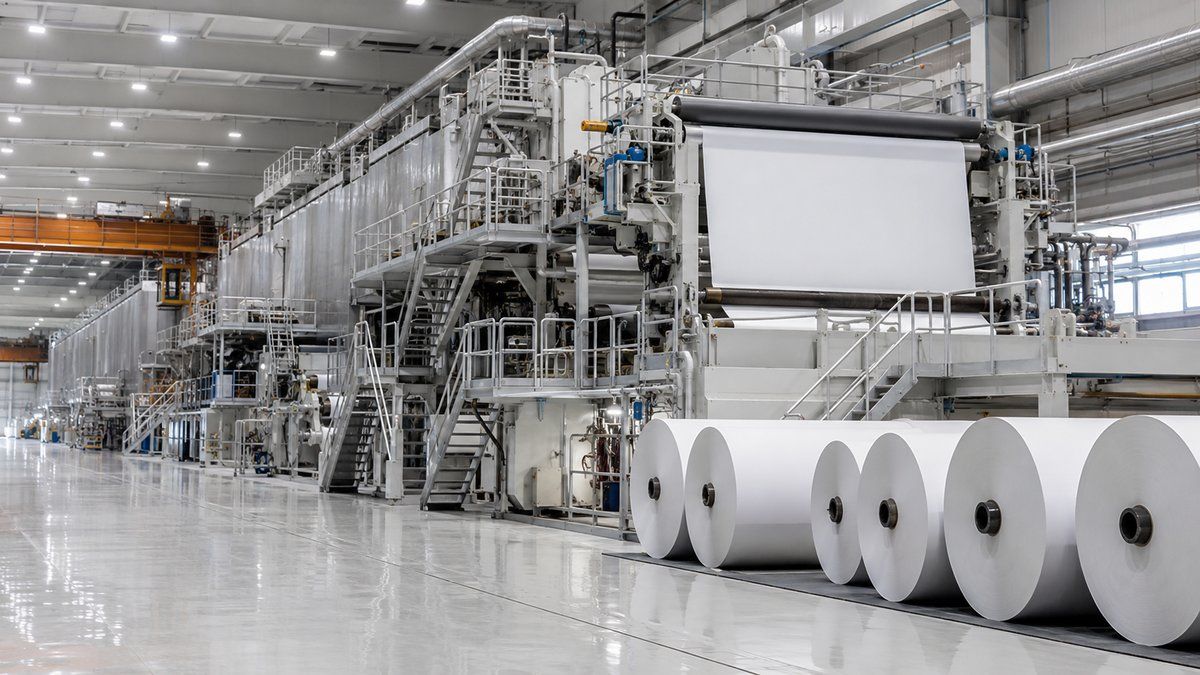
⚠️ Indicative cost ranges only. Equipment cost varies based on capacity, automation level, supplier (Indian vs imported), control system sophistication, and material specifications. Use these ranges for budgeting; confirm with supplier quotes for your specific project.
For a deeper breakdown of equipment by manufacturing stage, see our complete paper mill equipment list.
For a complete supplier comparison and quote process, see our guide on paper machine costs by capacity and grade or request a feasibility report.
How to Evaluate a Paper Machinery Vendor
The paper machine is 50 to 60 percent of your total project cost. Picking the wrong vendor compounds quality, downtime, and spare-parts cost problems for the entire life of the mill. Use this checklist before signing a purchase order with any supplier, Indian or imported.
The single highest-impact step: Visit two operating mills of any vendor you are considering. Speak to the operators, not the owners, about real-world downtime, spares availability, and after-sales responsiveness. This conversation will tell you more than any spec sheet.
Licenses, Permits, and Regulatory Requirements
Before machinery procurement, secure these licenses and approvals. Sequence matters. Consent to Establish from the State Pollution Control Board is the gating approval and should be initiated 6 to 9 months before commissioning.
Mandatory licenses and approvals
- Consent to Establish (CTE). State Pollution Control Board, before construction. Pulp & paper is in the "red" category per CPCB classification.
- Consent to Operate (CTO). State Pollution Control Board, before commercial production.
- Factory License. State Factories and Boilers Department under the Factories Act, 1948.
- NOC from local Gram Panchayat / Municipal Corporation, required for plot use.
- GST registration. Goods and Services Tax department.
- MSME Udyam Registration. Ministry of MSME (recommended for capex up to ₹50 crore for benefits).
- Import Export Code (IEC). DGFT, required if importing machinery or raw materials.
- Hazardous Waste Authorization, required for ETP sludge handling.
- Boiler License. Department of Industrial Safety and Health (for steam boiler operation).
- BIS Certification. Bureau of Indian Standards for specific paper grades (e.g., IS:1397 for kraft paper, IS:1060 for tissue).
Sources: CPCB, Ministry of MSME, DGFT, Bureau of Indian Standards.
Typical regulatory approval timeline: 4 to 9 months from CTE application to commercial production approval.
Government Schemes and Subsidies for Paper Mills in India
Indian government schemes can offset 15 to 35 percent of project capex if structured correctly. Most schemes are MSME-targeted (capex below ₹50 crore in plant & machinery).
State-specific schemes: Maharashtra Industrial Policy, Gujarat Industrial Policy, UP Industrial Investment Promotion Policy, and Telangana TS-iPASS each offer additional 10 to 25% capital subsidies for paper mills in designated zones.
Sources: Ministry of MSME, DGFT, PMEGP portal, state industrial policy publications.
Planning to apply for these schemes? Get a customized capex breakdown showing which schemes apply to your specific project (capacity, location, paper grade) and how much each can offset.
Best Indian States for Paper Mill Setup
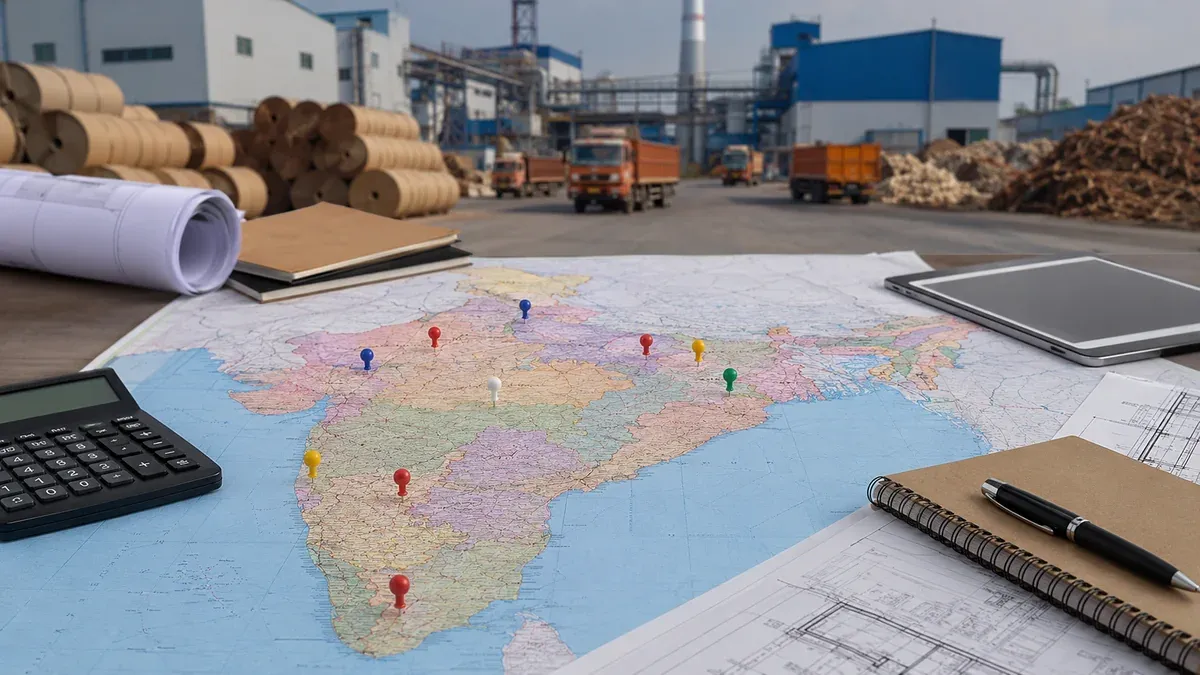
Site selection drives 15 to 25 percent of project economics through land cost, utility costs, labor rates, and approval timelines. Based on industry data from IPMA Statistics, the top paper-producing Indian states are:
For context on which paper companies operate at scale across these states, see the largest paper manufacturing companies ranking.
Site selection criteria (in priority order)
- Water access - 60 m³ minimum per tonne of paper produced. Verify groundwater table depth and surface water rights.
- Power reliability - 600 to 1,000 kWh per tonne. Industrial tariffs vary 20 to 30% across states.
- Raw material proximity. Within 500 km for waste paper sourcing; closer for recycled paper mills (transportation cost is 5 to 8% of opex).
- Pollution control approval timeline. Maharashtra and Gujarat typically issue CTE within 4 to 6 months; some states take 9 to 12 months.
- Effluent discharge norms. Coastal states often have stricter ZLD (Zero Liquid Discharge) requirements.
For state-specific industrial policy benefits, consult the respective state industrial development corporation websites.
Working Capital, ROI, and Break-even Analysis
Working Capital Requirements
Working capital typically ranges from 12 to 18 percent of total project capex, equivalent to 3 months of operating expenses. For a 50 TPD mid-scale mill (₹25 crore project), working capital requirement is ₹3 to ₹4.5 crore covering raw material inventory, finished goods, debtor cycle, and operating cash.
Break-even and Payback
Industry estimates from supplier-published reference projects and IPMA member benchmarks:
- Small recycled mills (5 to 20 TPD): Break-even 4 to 6 years, payback 5 to 7 years
- Mid-capacity mills (50 to 100 TPD): Break-even 3 to 5 years, payback 4 to 6 years
- Large integrated mills (300+ TPD): Break-even 2 to 3 years, payback 3 to 5 years
Return on Investment
Stabilized post-payback ROI typically 12 to 18 percent annually for well-managed mills with consistent capacity utilization above 80 percent. Below 70 percent utilization, mills typically operate at break-even or loss.
Note: Actual figures vary significantly by paper grade, capacity utilization, raw material strategy (virgin pulp vs recycled), and market pricing. The figures above are industry estimates; consult your specific project DPR for accurate financial modeling.
Operating Costs and Profitability
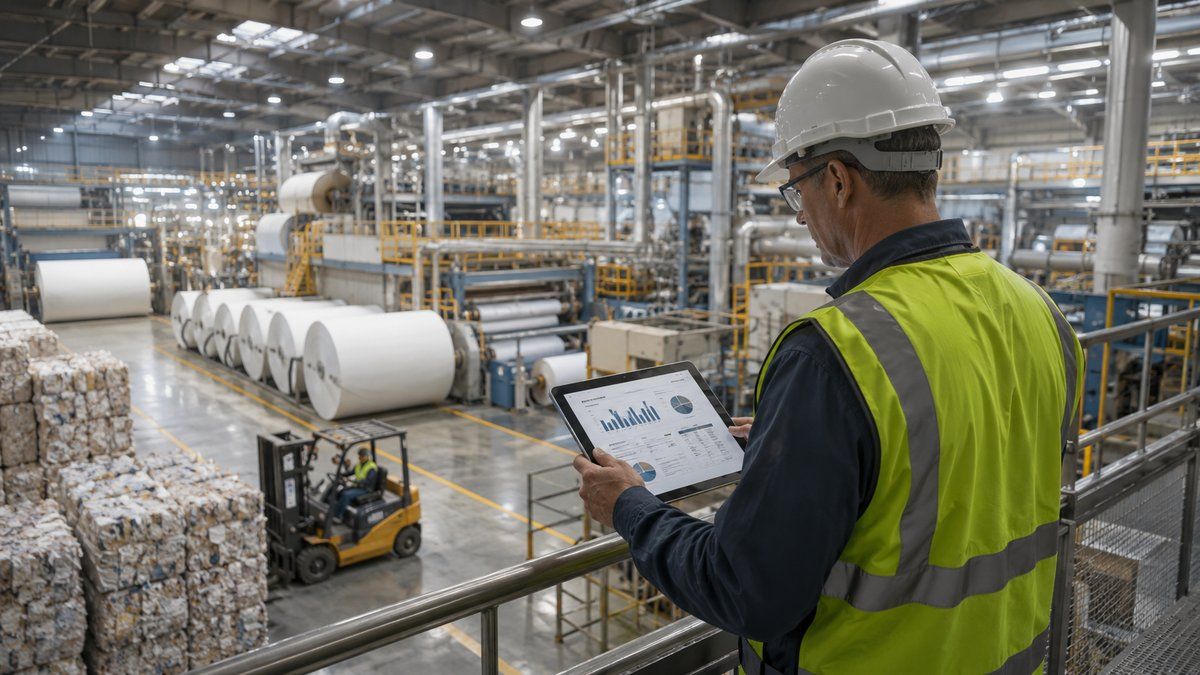
Operating costs determine post-stabilization profitability. Indian paper mills typically follow this opex structure (per IPMA member-published cost data and CRISIL industry research):
Profitability benchmarks (well-managed Indian mills):
- Gross margin: 25 to 35%
- EBITDA margin: 12 to 20%
- Net margin: 5 to 12%
For benchmarking, large global producers like International Paper, Smurfit Kappa, Stora Enso, and Suzano typically report EBITDA margins of 14 to 22% on integrated paper operations. Indian mid-scale mills with strong raw material strategy and capacity utilization above 80% can match the lower end of this global range. Domestic players like ITC Paperboards and JK Paper publish similar margin ranges in their annual reports.
These are industry estimates; actual margins vary based on paper grade premium, raw material strategy, and market timing.
Planning your paper manufacturing plant? Get a customized feasibility report including capex breakdown, machinery quotes, regulatory checklist, and ROI projection for your specific capacity and paper grade.
References & Sources
All figures, statistics, and regulatory references in this guide are sourced from authoritative industry publications and government bodies.
- IPMA (Indian Paper Manufacturers Association) Statistics — production volumes, state-wise output, market growth projections
- Central Pollution Control Board (CPCB) — environmental classification, effluent norms, ZLD requirements
- Ministry of Micro, Small & Medium Enterprises (MSME) — PMEGP scheme details, MSME Udyam registration, capital subsidies
- Directorate General of Foreign Trade (DGFT) — EPCG scheme, customs duty schedules, IEC code requirements
- Bureau of Indian Standards (BIS) — paper grade specifications (IS:1397, IS:1060), certification requirements
- PMEGP Portal (Khadi & Village Industries Commission) — Prime Minister's Employment Generation Programme details
- FAO Forest Products Statistics — global paper production and consumption data
- Industry capex benchmarks based on supplier-published reference projects (Indian and global OEM disclosures)
- CRISIL and ICRA published industry research (cited as "industry estimates" where exact figures are subscription-restricted)
This article was reviewed for technical accuracy by WPM Editorial Team and last updated May 7, 2026. If you find an error, please contact us at info@worldpapermill.com.


