

🔑 Key Takeaways: Paper Making Machine Cost (2026)
- Machine-only price range: $30K to $30M+ (₹28.8L to ₹288cr+), driven primarily by capacity (TPD), grade, and automation level.
- Per-TPD rule of thumb: Roughly $40K to $80K per TPD of machine capacity across mid-size tiers, based on supplier reference projects.
- Capacity is the biggest cost lever: A 50 TPD line costs roughly 5x to 8x a 10 TPD line, not 5x linearly.
- Total project cost is typically 2x to 2.5x the machine price once land, civil, utilities, and working capital are added (covered separately in our paper manufacturing plant cost guide).
- Country of manufacture impacts price meaningfully: Indian and Chinese machines are 30 to 50% cheaper than European or US equivalents, with trade-offs in automation and aftermarket support.
All figures are indicative ranges compiled from public supplier listings across Asia, Europe, and the Americas, the FAO Pulp and Paper Capacities Survey 2025, CEPI Key Statistics 2023 PDF, IPMA Statistics, and market intelligence references (RISI/Fastmarkets, IBISWorld), as of May 2026. Final pricing depends on configuration, geography, supplier, and grade requirements. Confirm via a custom quote before any commitment.
Introduction
A paper making machine is the single largest capital line item in any paper mill project, accounting for 40 to 50 percent of total project cost across most capacity tiers. Globally, machine-only prices range from around $30,000 for a small handmade or recycled-paper unit to over $30 million for a 200 TPD integrated tissue or kraft line, depending on configuration.
This guide focuses specifically on machine pricing: what you actually pay the paper machine supplier for the headbox, wire section, press, dryer, calendar, reel, and accompanying stock-prep equipment. It is grade-agnostic and geography-neutral, with pricing shown in USD and INR plus a multi-currency reference for buyers in EUR, GBP, CNY, JPY, CAD, BRL, IDR, NGN, PHP, and PKR markets.
For a side-by-side view of who actually supplies these machines worldwide, see our comparison of global paper machine manufacturers covering Voith, Valmet, Andritz, Parason, Toscotec, Baosuo, and other Tier-1 and mid-tier OEMs by capacity, speed, deckle width, and equipment scope.
For the broader question of total project cost (including land, civil works, utilities, working capital, and licensing, which together typically add 100 to 150 percent on top of the machine price), see our paper manufacturing plant cost guide for India. For the end-to-end industry overview, see the paper manufacturing pillar guide. For tissue-specific buying, see the tissue paper manufacturing machine price guide.
The global paper machinery market is estimated in the $9 to $12 billion range across major industry reports, with capacity additions concentrated in India, China, and Southeast Asia per the FAO Pulp and Paper Capacities Survey 2025.
Paper Making Machine Cost at a Glance (Quick Reference)
The master pricing table below shows indicative machine-only price ranges across eight capacity tiers. Prices reflect standard configuration (medium automation, mid-grade output) and do not include civil, utilities, or installation.
Indicative pricing ranges compiled from 2025 to 2026 supplier listings (IndiaMart, Made-in-China, Alibaba, EuropeanPaperMachines), industry capacity references (IPMA Statistics, CEPI Key Statistics 2023 PDF, CPPRI Annual Reports), and the FAO Pulp and Paper Capacities Survey 2025. Pricing depends on configuration, geography, and supplier. Request a custom quote for your exact spec.
Last updated May 2026. Pricing varies with steel prices, currency rates, automation level, and supplier choice. Confirm via our equipment inquiry form.
Multi-Currency Reference (10 paper-industry markets)
For buyers outside USD and INR markets, here is a conversion reference for a representative 50 TPD mid-size line at $4,000,000 (the midpoint of the 50 TPD range). Actual machine pricing is quoted in the supplier's home currency and converted at transaction date.
Conversions based on average 2026 exchange rates per OANDA, ECB, US Federal Reserve, and other central bank references. Actual rates fluctuate daily.
What's Included in a Paper Making Machine Price?
A paper making machine quote almost always covers four production zones plus stock preparation, but the exact scope varies by supplier. Understanding what is bundled and what is sold separately is the single biggest source of quote-to-quote variance.
Stock preparation section prepares the pulp slurry for the paper machine. It typically includes pulper, high-density cleaner, refiner, pressure screen, and approach flow system. On most quotes this represents 12 to 18 percent of total machine cost.
Wet end (forming and press) is where the paper sheet is actually formed. The headbox distributes pulp evenly onto the wire section (Fourdrinier or twin-wire former), which drains water and forms the wet sheet. The press section then squeezes additional water out using press rolls. Together, the wet end represents 25 to 35 percent of machine cost.
Dry end (drying, calendaring, and reeling) is the most expensive zone, typically 40 to 50 percent of machine cost. Steam-heated dryer cylinders remove the remaining moisture, the calendar smooths and compacts the sheet, and the pope reel winds the finished paper for downstream conversion.
Auxiliary systems include the DCS (distributed control system) for automation, the steam boiler and vacuum systems, and the chemicals dosing station. These are sometimes quoted separately, which is why two superficially similar quotes can differ by 20 to 30 percent.
Indicative Component Pricing (20 TPD reference line)
Component pricing ranges based on Xinyun, AGICO, and supplier public reference projects. Pricing varies with material, automation level, and supplier. These are reference midpoints, not commitments.
What is NOT included in a typical machine quote: land, civil construction, building, electrical infrastructure, water treatment, effluent treatment plant (ETP), licensing, installation labor, operator training, and working capital. These are covered in the paper manufacturing plant cost guide.
7 Factors That Drive Paper Making Machine Cost
Machine pricing varies by a factor of 1,000x across the global market, from $30,000 small handmade units to $30 million large integrated lines. Seven variables explain most of that spread.
1. Capacity (TPD): the biggest driver. Capacity is measured in tons per day (TPD), and machine cost scales sub-linearly with TPD. Doubling capacity rarely doubles the price. A 50 TPD machine typically costs around 4x to 5x a 10 TPD machine, not 5x exactly, because shared subsystems (DCS, headbox, dryer hood) gain less in cost as throughput rises. This is the main reason most mid-size investors target 30 to 80 TPD, where capex efficiency is highest.
2. Paper grade. The grade you intend to produce changes the configuration substantially. Tissue paper machines need a Yankee dryer and a creping doctor, which adds $400K to $1.5M depending on capacity. Duplex board machines need a multi-ply former, which is more complex than a Fourdrinier and adds 15 to 25 percent to machine cost. Writing-printing paper machines need sizing stations and calendars optimized for surface finish, which adds 10 to 20 percent. Recycled paper machines are usually the cheapest at any given capacity because they accept variable feedstock and run at moderate speeds.
3. Deckle (wire width). The trim width of the paper sheet determines machine width. Narrow machines (1.5m to 2.5m) suit handmade, specialty, and small kraft operations. Standard machines (3m to 4.5m) suit most kraft, tissue, and writing applications. Wide machines (5m to 8m+) are reserved for large integrated newsprint and packaging mills. Each meter of width adds roughly 8 to 12 percent to machine cost.
4. Speed (m/min). Machine speed ranges from 50 m/min for handmade units to 1,800+ m/min for high-speed tissue and newsprint machines. Speed directly drives throughput per meter of width, so a 200 m/min 3m machine and a 100 m/min 6m machine produce comparable tonnage. Higher speed requires heavier construction, faster drives, and tighter tolerances, which adds 15 to 30 percent over slow-speed equivalents.
5. Automation level. Manual machines with basic instrumentation cost least. Semi-automatic machines with PLC control add 10 to 20 percent. Fully automatic DCS-controlled machines with quality control systems, condition monitoring, and remote diagnostics add 25 to 50 percent over a manual baseline. Higher automation pays back in labor reduction and consistency, which matters more at higher capacities.
6. New vs refurbished. A refurbished machine from a closed European or North American mill can cost 30 to 60 percent less than a new equivalent, but carries meaningful risk. Wear on dryer cylinders, headbox edges, and drives may not be apparent until commissioning, and spare parts for older OEMs can be difficult to source. Refurbished machines suit buyers with strong technical due-diligence capacity. New machines suit first-time buyers and capacity-critical projects.
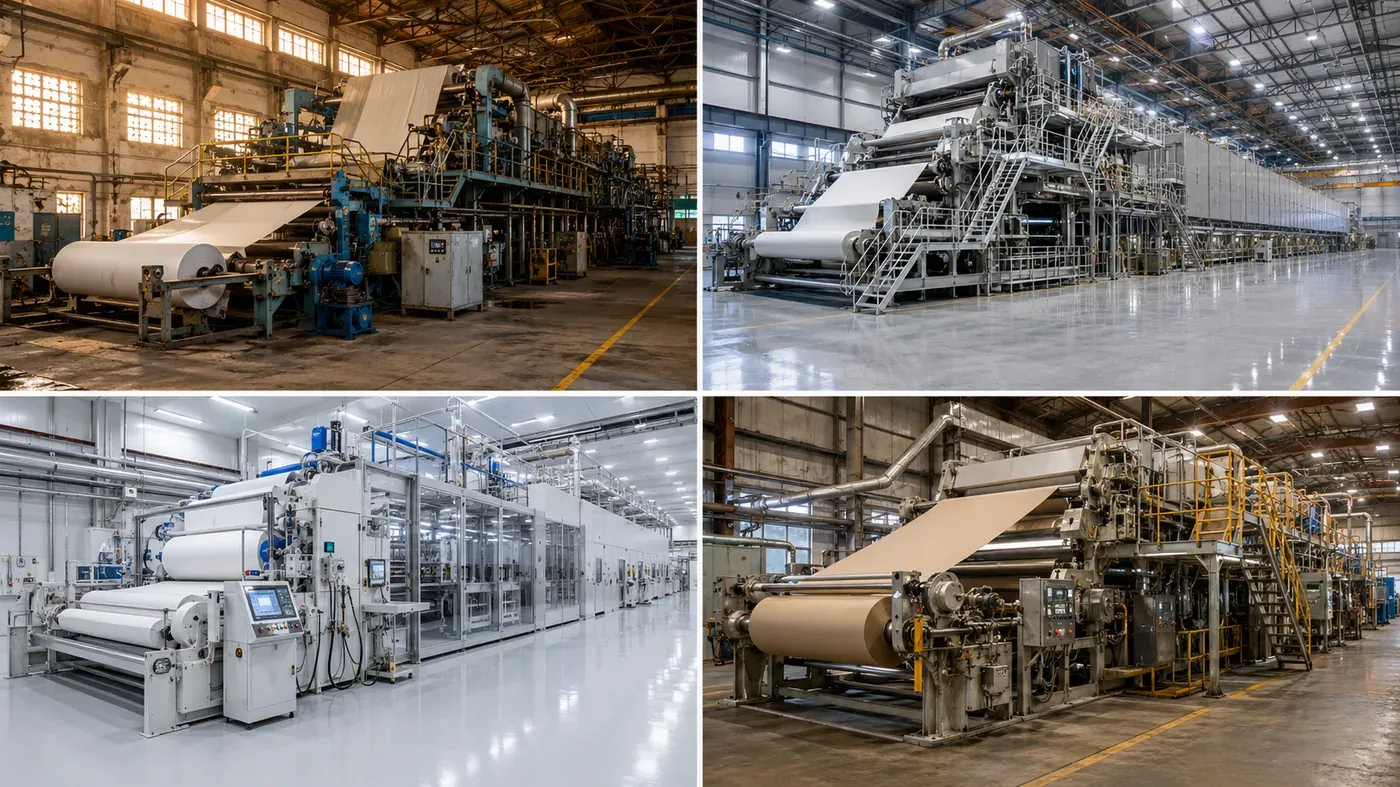
7. Country of manufacture.
Price by Paper Grade
While the master capacity table gives a useful overall reference, real buying decisions are grade-specific. Below is an indicative price range for the four largest paper grades plus recycled and specialty categories, all at 50 TPD reference capacity.
Grade-specific pricing reflects standard mid-automation configuration at 50 TPD. Add 20 to 40 percent for high-automation specs, deduct 10 to 20 percent for Indian or Chinese supply, deduct 25 to 40 percent for refurbished. Pricing varies materially with deckle width and speed. Confirm via custom quote.
Kraft paper machines
Kraft paper accounts for the largest share of global packaging-grade paper production. A 50 TPD kraft machine typically ranges from $2.2M to $5.5M (₹21.1cr to ₹52.8cr) depending on whether it is virgin kraft or recycled kraft. Indian suppliers dominate the 20 to 80 TPD tier with strong cost efficiency. For deeper context on the production process and equipment, see our kraft paper manufacturing process guide.
Tissue paper machines
Tissue requires a Yankee dryer (a large steam-heated cylinder, 12 to 18 feet in diameter) plus a creping doctor blade, which adds materially to cost over a flat-paper machine. A 50 TPD tissue line typically ranges from $3M to $7M (₹28.8cr to ₹67.2cr). Tissue speeds run higher than most other grades (1,000 to 2,000 m/min for premium lines), driving up the cost of drives and quality systems. For a tissue-specific buying guide, see our tissue paper manufacturing machine price guide.
Duplex board machines
Duplex board uses a multi-ply former (typically 3 to 5 plies) which is more complex than a Fourdrinier. A 50 TPD duplex machine ranges from $3.2M to $7M (₹30.7cr to ₹67.2cr). Most duplex investment is currently concentrated in India, China, and Southeast Asia, driven by FMCG packaging demand.
Writing and printing paper machines
Writing-printing grades require fine surface control through sizing stations and a calendar optimized for smoothness. A 50 TPD writing-printing machine ranges from $2.8M to $6.5M (₹26.9cr to ₹62.4cr). Production has been declining globally as digital substitution reduces office paper demand, so the new-build market is small and refurbished options are widely available.
Recycled paper machines
Recycled lines are typically the most economical at any given capacity because they accept variable feedstock and run at moderate speeds. A 50 TPD recycled line ranges from $1.8M to $4.5M (₹17.3cr to ₹43.2cr) at the machine level. Stock preparation and deinking add 30 to 50 percent more in capex versus virgin lines, partly offsetting the machine savings. For the full equipment scope, see our waste paper recycling plant machinery guide.
Specialty grades (bagasse, bamboo, agricultural residue)
Specialty grades using non-wood fiber typically cost 15 to 30 percent more than equivalent wood-pulp machines because of the additional pre-processing (depithing, washing, screening for high silica or non-fiber content). A 50 TPD bagasse-based kraft machine ranges from $3M to $6M (₹28.8cr to ₹57.6cr).
Total Project Cost: Beyond the Machine
The paper machine is one line item, but the total project cost typically runs 2x to 2.5x the machine price once everything else is included. Below is the standard breakdown.
So for a $4M machine (50 TPD reference), expect a total project budget of $8M to $10M. For a $30M machine (200 TPD), expect $60M to $75M total project.
For a detailed India-specific project cost breakdown with state-level land prices, applicable subsidies (PMEGP, EPCG, CGTMSE), and licensing checklists, see our paper manufacturing plant cost in India guide.
ROI Math: Payback Period for a Paper Mill
A worked example for a 50 TPD kraft paper mill, using publicly published reference economics. Numbers are illustrative and should be replaced with your own DPR (Detailed Project Report) for any real decision.
Capex
- Paper machine (mid-automation): $4,000,000 (₹38.4cr)
- Total project (2.2x machine): $8,800,000 (₹84.5cr)
Annual production
- Operating days per year: 330 (global industry average per IPMA Statistics and CEPI Key Statistics 2023 PDF, allowing for maintenance shutdowns)
- Annual output: 50 TPD × 330 days = 16,500 metric tons per year
Revenue
- Kraft paper average selling price (2025 to 2026): $700 to $900 per metric ton ex-mill, based on supplier listings and trade references (general range; see FAOSTAT-Forestry for production and trade data)
- Annual revenue at $800/ton midpoint: $13,200,000 (₹126.7cr)
Operating costs (typical kraft mill, indicative blend per CPPRI Annual Reports, CEPI Key Statistics 2023 PDF, and supplier benchmarks)
- Raw materials (waste paper, chemicals, pulp): 50% to 55% of revenue
- Energy (steam, electricity): 12% to 15% of revenue
- Labor and overhead: 6% to 8% of revenue
- Maintenance and consumables: 3% to 5% of revenue
- Total OpEx: roughly 70 to 75% of revenue
Gross margin and payback
- EBITDA margin (typical kraft mill): 25% to 30% of revenue
- Annual EBITDA at 28% midpoint: $3,700,000 (₹35.5cr)
- Simple payback on total project: roughly 2.5 to 3 years
- Simple payback on machine only: roughly 1.1 to 1.4 years
Payback ranges by grade
Payback assumes 100% capacity utilization from year 2 onward, which is rarely achieved in practice. Real-world payback is typically 12 to 24 months longer once ramp-up and working capital cycles are factored in.
New vs Used Paper Making Machine
Refurbished machines from closed European or North American mills can offer 30 to 60 percent savings versus equivalent new equipment, but carry meaningful risk that most first-time buyers underestimate.
When refurbished makes sense:
- You already operate a similar machine and have in-house technical expertise.
- You can do thorough on-site inspection (or hire an independent technical consultant) before purchase.
- You have working capital reserve for unexpected commissioning issues.
- You are buying secondary capacity, not your only production line.
When new makes sense:
- First paper mill investment.
- High automation required for end-product quality consistency.
- Specific grade requirements (tissue with Yankee, multi-ply board) where used inventory is thin.
- Financing is contingent on warranty (banks often refuse to finance used industrial equipment without OEM-backed support).
How to Get an Accurate Quote
Supplier quotes vary widely until the buyer provides a clear technical spec. The 8-point checklist below covers what every supplier will ask in the first round of conversation. Having this ready cuts quote turnaround from 4 to 6 weeks down to 1 to 2 weeks.
- Paper grade: kraft, tissue, duplex board, writing-printing, recycled, or specialty.
- GSM range: grams per square meter (e.g., 60 to 120 GSM for writing, 14 to 22 GSM for tissue).
- Capacity in TPD: design capacity, not maximum theoretical.
- Deckle width: trim width of finished paper in meters.
- Machine speed: design speed in m/min (suppliers will optimize from this).
- Automation level: manual, semi-automatic with PLC, or full DCS with quality systems.
- Raw material source: virgin pulp, waste paper grade (OCC, ONP, mixed office), or agricultural residue.
- Project location: for sea/land freight, installation logistics, and aftermarket coverage.
Once you have these, request quotes from 3 to 5 suppliers across at least two countries of manufacture (e.g., two Indian suppliers, one Chinese, one European). For supplier shortlists by grade and capacity, request a custom inquiry or browse our business directory.
Paper Machinery Supplier Landscape
The global paper machinery supplier landscape spans India, China, Europe, and the United States. Below is an overview of leading manufacturers organized by region, with their typical capacity sweet spot.
Capacity sweet spot reflects the band where each region's manufacturers tend to be most cost-competitive, based on supplier-published reference projects. Indian and Chinese manufacturers dominate the small-to-mid-size tier where capex efficiency matters most. European manufacturers lead the high-automation, large-capacity segment. North American suppliers are strong in specialty tissue and refurbished equipment.
This table is for reference only. WPM compiles manufacturer information from public industry presence; it does not endorse any specific supplier. Always conduct independent technical and financial due diligence before any procurement decision.
For a vetted shortlist matched to your project specs, request a custom inquiry or browse the complete supplier directory. Are you a paper machinery manufacturer? List your business free and reach industry buyers worldwide.
Sources & References
Global
- FAO Pulp and Paper Capacities Survey 2025 — annual global capacity forecast: https://www.fao.org/forestry-fao/statistics/80571/en/
- FAOSTAT-Forestry Database — production and trade statistics for pulp, paper, and paperboard: https://www.fao.org/forestry-fao/statistics/84922/en/
- TAPPI — Technical Association of the Pulp and Paper Industry (United States), equipment standards: https://www.tappi.org/
- RISI / Fastmarkets — referenced for market intelligence (paid subscription)
Europe
- CEPI Key Statistics 2023 (PDF) — Confederation of European Paper Industries, annual statistics report: https://www.cepi.org/wp-content/uploads/2024/09/Key-Statistics-2023-FINAL-2.pdf
India and Asia
- IPMA Statistics — Indian Paper Manufacturers Association industry statistics (production, import, export): https://ipmaindia.org/statistics-2/
- CPPRI Annual Reports — Central Pulp & Paper Research Institute, downloadable annual reports with operating data: https://cppri.res.in/en/downloads/annual-report
- IPPTA — Indian Pulp & Paper Technical Association: https://www.ippta.co/
Exchange rate references
- OANDA historical FX rates, European Central Bank (EUR), US Federal Reserve (USD), Bank of England (GBP), and national central banks for all other currencies shown.


