

Paper is a thin, flat material made by pressing wet cellulose fibers together and drying them into flexible sheets. Globally, paper and paperboard production reached about 419 million tonnes in 2024 with Q1 2026 estimates near 425 million tonnes, with China, the USA, Japan, Germany, and India as the top five producing nations (FAO Forestry Database, 2025 statistical yearbook). The global pulp and paper market is valued at around USD 394 billion in 2025 and roughly USD 410 billion in 2026, projected to reach USD 551 billion by 2034 at 3.8% CAGR (Precedence Research 2025-2026 outlook). Paper remains one of the most widely used materials in the world: from printing and packaging to hygiene products and industrial applications.
This guide covers what paper actually is, what it's made from, how it's manufactured, the different types and grades, and where the global paper industry stands today.
What Is Paper? A Simple Definition
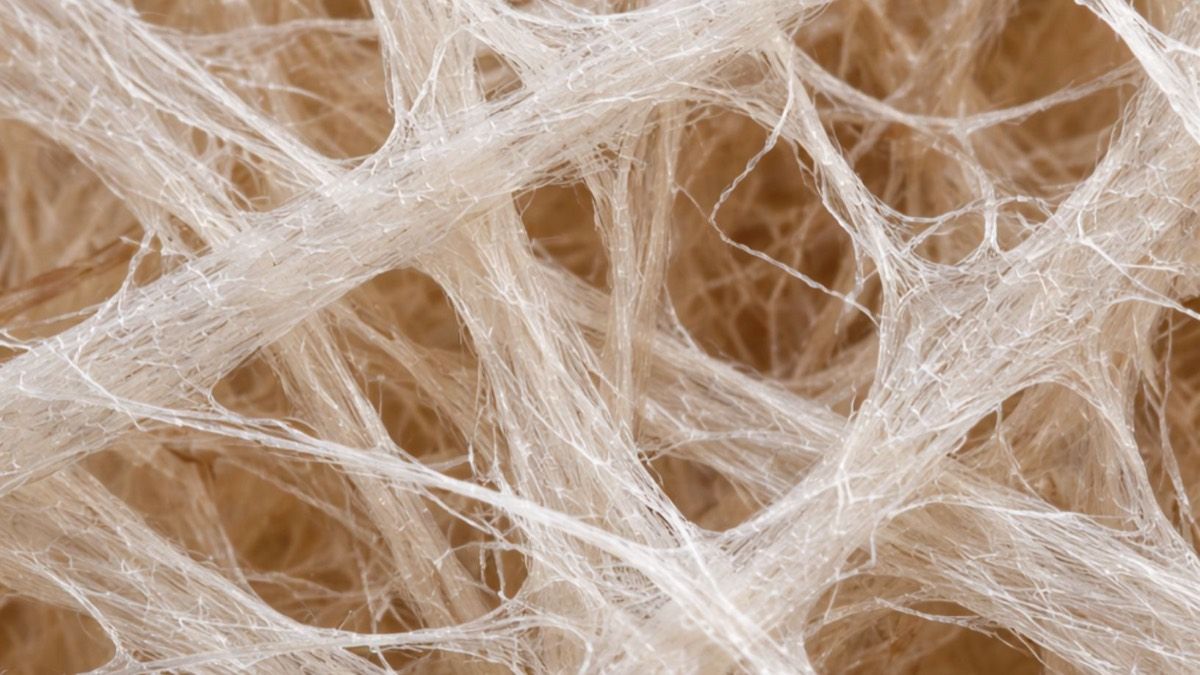
Paper is a sheet material composed of cellulose fibers: tiny plant-based strands bonded together through a process of pulping, pressing, and drying. These fibers are typically sourced from wood, but can also come from cotton, bamboo, bagasse (sugarcane waste), hemp, or recycled paper.
The key characteristic that makes paper different from other sheet materials is this: the plant fibers are broken down (either mechanically or chemically) into a pulp, suspended in water, spread across a mesh screen, and then pressed and dried into a uniform sheet. This process fundamentally changes the structure of the original plant material, creating something entirely new.
A standard sheet of office paper (A4 size, 80 GSM) contains roughly 5 grams of cellulose fiber: the equivalent of a small handful of wood chips processed down to microscopic strands.
Paper vs Papyrus: Why Is It Called “Paper”?
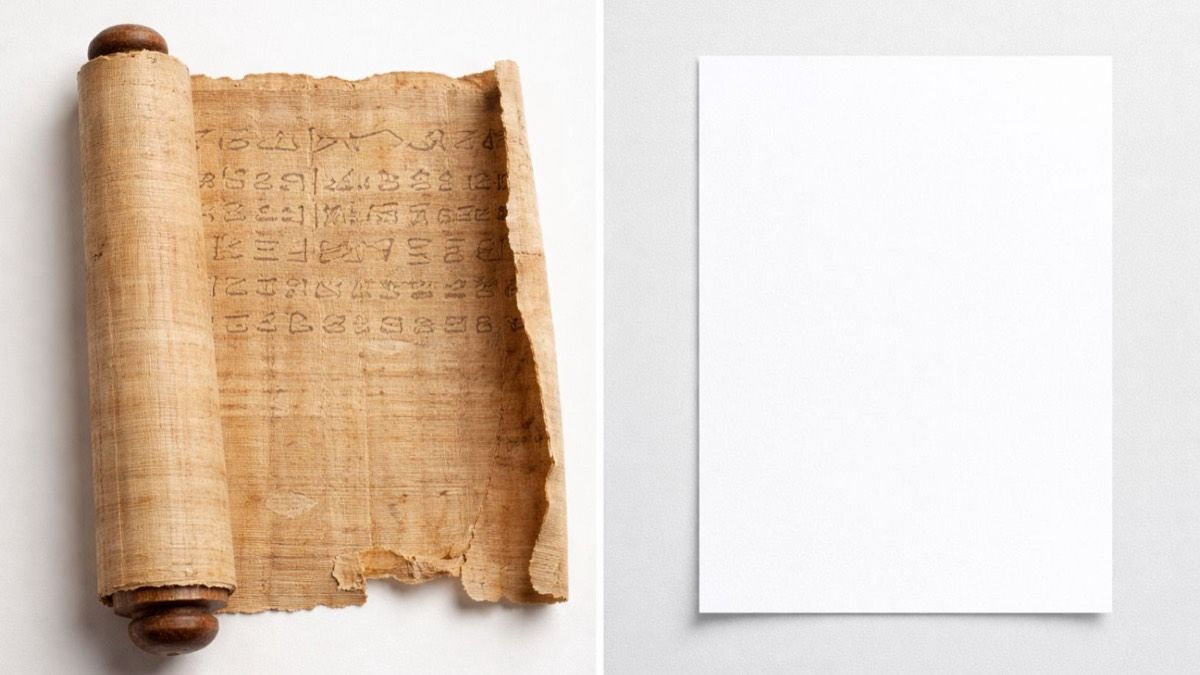
The English word “paper” comes from the Latin papyrus, which itself derives from the Greek papyros: the name for the Cyperus papyrus plant used in ancient Egypt. Despite the shared name, paper and papyrus are completely different materials made through different processes.
Source: Encyclopedia Britannica, Smithsonian Institution. Historical dates are approximate and based on archaeological evidence.
Papyrus uses the natural plant strips in their original form: essentially a laminate. Paper involves breaking down plant material into individual fibers and reconstituting them into something new. The technology originated independently in China around 105 AD, credited to Cai Lun, a court official of the Han Dynasty.
History of Paper: From China to the Modern World
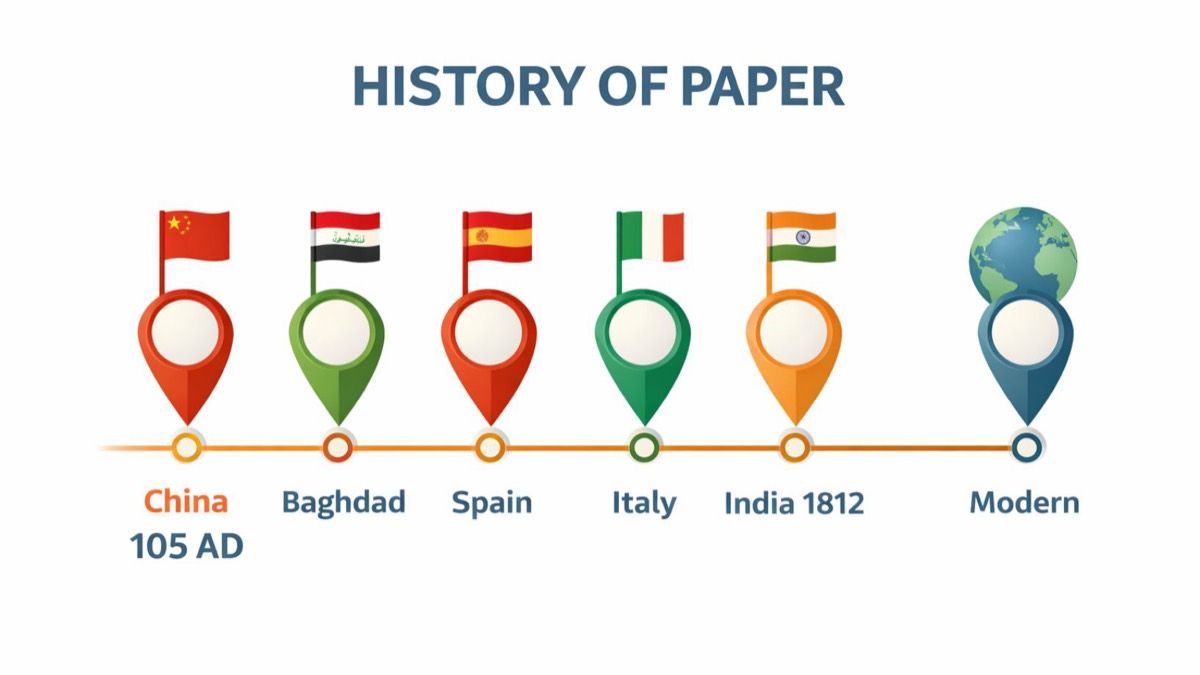
Note: Dates shown in the infographic are approximate and based on widely accepted historical records. Some dates may vary depending on the historical source.
Paper has a 2,000-year journey from a Chinese court invention to the backbone of modern communication and packaging.
Source: Encyclopedia Britannica, Needham’s Science and Civilisation in China, IPMA. Dates are based on historical records and may vary by source.
Before wood pulp became the standard in the mid-1800s, paper was made primarily from cotton and linen rags: making it expensive and scarce. The shift to wood pulp transformed paper from a luxury into an everyday material.
First Paper Mill in India
India's papermaking history dates back to 1812 when the first paper mill was established at Serampore (Srirampur) in West Bengal, along the banks of the Hooghly River. The Serampore missionaries: William Carey, Joshua Marshman, and William Ward: set up this mill to support their printing operations. However, the mill was short-lived due to limited market demand at the time.
The next significant development came in 1870 with the Royal Bengal Paper Mills in Ballygunge, Kolkata. Today, India is the world's fastest-growing paper market, with consumption reaching near 24.2 million tonnes in 2025 (IPMA 2025-26 statistics) and projected to hit 30 million tonnes by FY 2026-27. Read more about the growth of the paper industry in India.
What Is Paper Made Of?
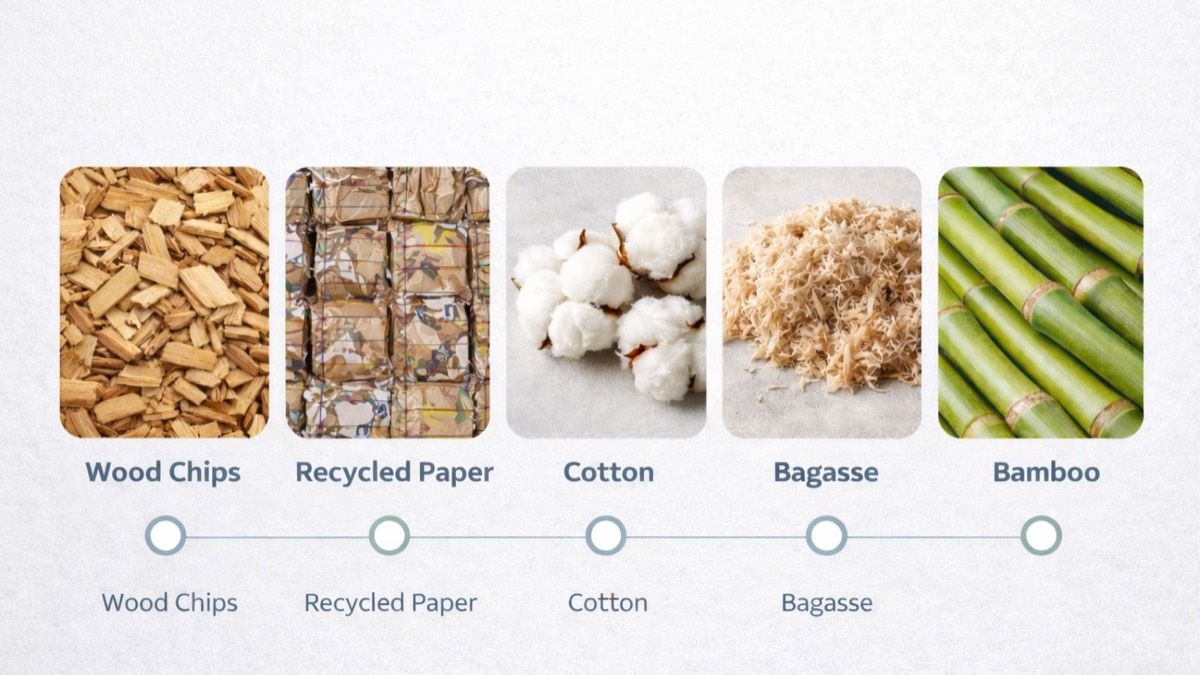
Note: Fiber quality descriptions and usage classifications shown are general industry guidelines. Actual properties depend on species, growing conditions, and processing methods.
The primary raw material in papermaking is cellulose fiber. For a deeper look at sourcing, see our complete raw materials list. While wood is the most common source today, paper can be manufactured from several fiber sources:
Source: TAPPI, FAO Forest Products Yearbook, US EPA. Fiber characteristics represent typical industry classifications; actual properties vary by species and processing method.
Beyond cellulose, paper production uses several chemical additives:
- Sizing agents (like AKD or ASA): make paper water-resistant so ink doesn't bleed
- Fillers (calcium carbonate, kaolin clay): improve brightness and smoothness
- Retention aids: help fine fibers bond to the sheet during forming
- Bleaching chemicals (chlorine dioxide in ECF process, hydrogen peroxide in TCF): whiten the pulp
- Alum (aluminium sulphate): traditionally used for sizing, helps control pH and remove microorganisms
On average, producing one tonne of paper requires ~ 17 trees and 30,000 litres of water (US EPA). This is why recycled paper is increasingly important: recycling cuts water consumption by up to 78% compared to virgin pulp production. For a full list of chemicals used in paper mills, see our dedicated guide.
How Is Paper Made? The 5-Step Process
Modern papermaking follows five fundamental steps, whether producing tissue paper or heavy-duty packaging board:
Step 1: Pulping
Raw material (wood chips, recycled paper, or alternative fibers) is converted into pulp. This happens through:
- Mechanical pulping: wood is physically ground against a rotating stone or between metal discs. Yields 85-95% of the wood but produces weaker fibers.
- Chemical pulping (Kraft process): wood chips are cooked in chemicals (sodium hydroxide + sodium sulphide) at high temperature. Yields 40-50% but produces much stronger fibers. The Kraft process accounts for an estimated 70% of global paper production. See our detailed comparison of chemical vs mechanical pulping.
Step 2: Cleaning & Screening
The pulp is cleaned to remove contaminants: sand, dirt, ink (in recycled paper), plastic fragments, and other impurities. Screens and centrifugal cleaners separate unwanted material. If white paper is needed, the pulp is bleached at this stage.
Step 3: Forming
The cleaned pulp (now a slurry of ~99% water and ~1% fiber) is spread across a moving wire mesh screen. Water drains through the mesh, and fibers bond together randomly to form a wet sheet. This happens on a Fourdrinier machine or a cylinder mould: at speeds up to 100 km/h on modern machines.
Step 4: Pressing & Drying
The wet sheet (still ~60% water) passes through heavy press rollers that squeeze out water mechanically. Then it moves through a series of steam-heated cylinders that evaporate remaining moisture down to about 5-8% water content.
Step 5: Finishing
The dried sheet is calendered (pressed between smooth rollers) for uniform thickness and surface smoothness. Depending on the end product, it may be coated (for glossy magazine paper), embossed (for textured stationery), or left uncoated (for copy paper).
For a detailed breakdown with equipment specifications, see our full guide on the paper manufacturing process.
Types of Paper & GSM Grades
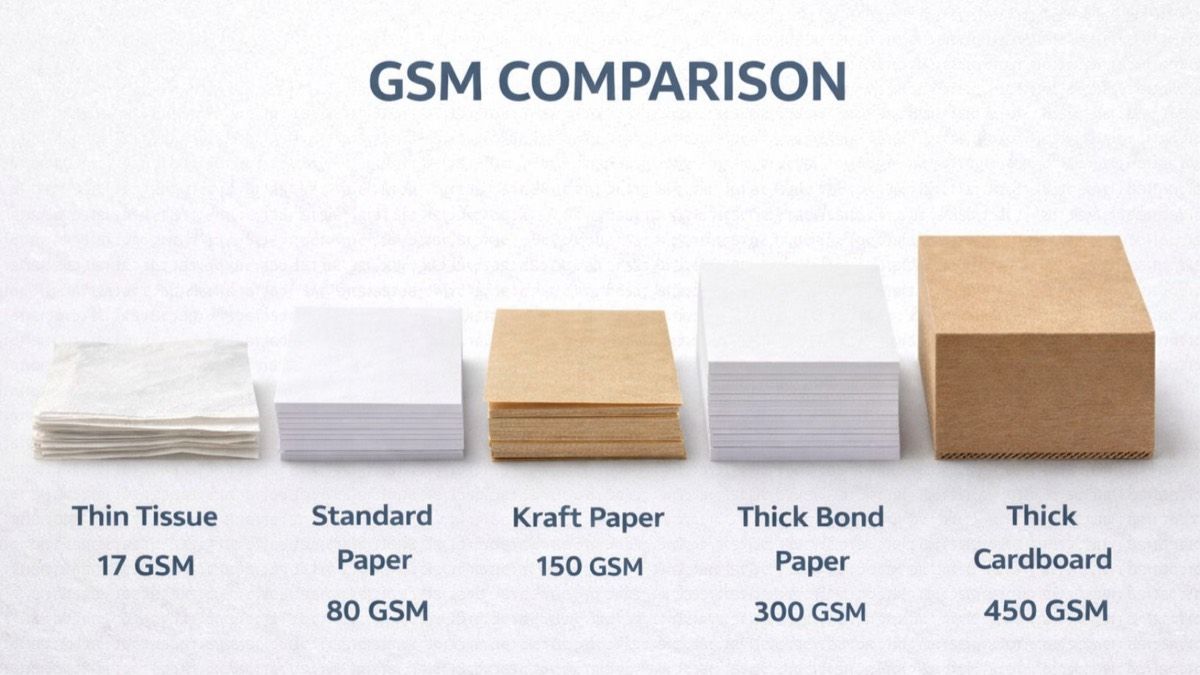
Note: GSM values shown are typical industry ranges and may vary by manufacturer, region, and specific product grade.
Paper types vary widely based on their intended use. The weight and thickness of paper is measured in GSM (grams per square meter): the weight of a single sheet measuring 1m x 1m.
Source: TAPPI Standards, ISO 536 (paper grammage), industry manufacturer specifications. GSM ranges are typical values; actual specifications vary by manufacturer and product grade.
How to Choose the Right GSM
- Under 80 GSM: Lightweight: newspapers, receipts, tissue
- 80-120 GSM: Standard: office paper, letters, basic printing
- 120-200 GSM: Medium weight: flyers, posters, book covers
- 200-350 GSM: Heavy: business cards, postcards, premium packaging
- 350+ GSM: Board grade: rigid packaging, structural applications
The difference between 80 GSM and 120 GSM paper is immediately noticeable: the heavier paper feels more substantial, resists curling, and prints with sharper definition.
Paper Industry Today: Key Statistics (2025-2026)
The global paper industry is massive: and still growing, driven primarily by packaging demand even as printing paper declines.
Global Production & Market Size
- Total production: ~419 million tonnes in 2024, ~425 million tonnes Q1 2026 estimate, up 2-3% YoY (FAO Forestry Database, 2025 statistical yearbook)
- Market size: USD 394 billion in 2025, ~USD 410 billion in 2026, projected to USD 551 billion by 2034 at 3.8% CAGR (Precedence Research 2025-2026 outlook)
- Consumption forecast: Growing from ~419 million tonnes (2024) to ~485 million tonnes by 2032 driven by packaging and tissue demand (FAO 2025 outlook)
- European production: Declined ~1.5% in 2025 due to energy costs and graphic-paper demand contraction (CEPI Preliminary Statistics, February 2026). Q1 2026 outlook indicates continued mild contraction in graphic paper, offset by packaging growth.
Top 10 Paper Producing Countries (2025 Latest Available)
Sources: FAO Forestry Database (2025 statistical yearbook), CEPI Preliminary Statistics (February 2026). Q1 2026 estimates from RISI China outlook and AF&PA Q1 2026.
China alone produces one-third of the world's paper. Asia collectively accounts for over 50% of global output.
India's Paper Industry (2025-2026)
India is the world's fastest-growing paper market:
- Current consumption: ~24.2 million tonnes in 2025 (IPMA 2025-26 final statistics)
- Growth rate: 6-7% annual growth; packaging paper growing at 8.2%, tissue at 9-11% (IPMA 2026 outlook, India Paper Manufacturers Association)
- Projected consumption: 30 million tonnes by FY 2026-27
- Per capita consumption: 16 kg (vs world average of 57 kg and USA's 221 kg): significant room for growth
- Market value: USD 10.71 billion in 2025 (~₹89,000 Cr), projected to USD 13.02 billion by 2033 at 2.4% CAGR (IMARC Group 2025-2026 update)
- Paper packaging market: USD 19.07 billion in 2025 (~₹1.58 lakh Cr), projected to USD 54.67 billion by 2031 at 19.16% CAGR (Mordor Intelligence 2026 paper packaging India update)
- Packaging paper accounts for 65% of India's paper consumption (15+ million tonnes)
Sources: IPMA 2025-26 final statistics, IMARC Group 2025-2026 update, Mordor Intelligence 2026 paper packaging India report, FAO Forestry Database 2025.
The low per capita consumption (16 kg vs 57 kg global average) indicates significant room for growth, making India one of the most attractive markets for paper industry investment.
Recycling & Environmental Impact (2025-2026)
- Global recycling rate: ~60% of paper is recycled worldwide
- Europe leads: 79.3% recycling rate in 2024 (record high); Q1 2026 estimate holds at 79-80% (CEPI 2025 final + February 2026 preliminary statistics)
- EU packaging paper: 83.2% recycling rate for paper packaging waste in 2024 (Eurostat 2025 final figures)
- Germany: 74% of all paper in circulation recycled
- UK: 74.3% paper recycling rate in 2024, 2025 estimate 74-75% (DEFRA 2025-2026 environment reports)
- USA: 60-64% paper recycling rate; 46 million tonnes recycled in 2024 with similar volumes in 2025 (AF&PA March 2025 + Q1 2026 outlook)
- Environmental cost: 1 tonne of virgin paper = ~17 trees + ~30,000 litres of water
- Recycling benefit: Cuts water use by up to 78% vs virgin production
- Carbon footprint: Paper industry accounts for ~1% of global CO2 emissions
Is Paper a Raw Material or a Finished Product?
Paper is both: depending on context. As a product, paper is the finished output of paper mills. But paper also serves as a raw material for:
- Packaging manufacturers (corrugated boxes, cartons)
- Printing companies (books, newspapers, magazines)
- Tissue converters (toilet paper, napkins, towels)
- Specialty applications (filter paper, medical wipes, insulation)
In industrial classification, paper is categorized as a semi-finished product: a manufactured material used as input for further manufacturing.
Machine Made Paper vs Handmade Paper
Machine-made paper is produced in large buildings called paper mills. Modern paper mills run continuously, producing sheets at speeds exceeding 100 km/h on machines that can be over 200 metres long. To understand how a paper mill works, it helps to know the full chain: from stock preparation to the finished reel.
Handmade paper, by contrast, is produced sheet by sheet using a mould and deckle (a frame with a mesh screen). Each sheet is individually formed, pressed, and dried. Handmade paper is prized for:
- Unique texture and deckle edges
- Superior strength (fibers align randomly in all directions)
- Specialty applications (art, certificates, luxury stationery)
India has a strong handmade paper tradition, with production centers in Jaipur, Pondicherry, and Sanganer. The Khadi and Village Industries Commission (KVIC) supports handmade paper production as a cottage industry.
Kertas Adalah: Pengertian dalam Bahasa Indonesia
Kertas adalah material tipis berbentuk lembaran yang dibuat dari serat selulosa yang ditekan dan dikeringkan. Bahan baku utama kertas adalah pulp kayu (dari pohon pinus, eucalyptus, atau bambu) atau serat daur ulang dari kertas bekas. Proses pembuatan kertas (pengertian kertas) meliputi 10 tahap industri: persiapan bahan baku, pulping, pembersihan, pemutihan, refining, pembentukan, pressing, pengeringan, calendering, dan pemotongan. Produksi kertas global pada tahun 2025 mencapai sekitar 410 juta ton (FAO Forestry Database 2025), dengan Indonesia sebagai salah satu produsen utama di Asia Tenggara.
Definisi kertas dalam industri: kertas adalah lembaran selulosa dengan grammage (GSM) 35 hingga 400 g/m², dengan brightness 60-92% ISO, dan kadar air 4-8%. Lihat proses produksi kertas (10 tahap) untuk detail teknis dan daftar bahan baku kertas untuk seluruh kategori material.
कागज क्या है? (Kagaj Kise Kahate Hain)
कागज (kagaj) सेल्यूलोज फाइबर से बनी एक पतली, सपाट सामग्री है जिसे लकड़ी की पल्प, बांस, गन्ने के बगास, या रिसाइकल्ड पेपर से बनाया जाता है। कागज बनाने की प्रक्रिया (paper manufacturing) में 10 औद्योगिक चरण शामिल हैं: कच्चे माल की तैयारी, पल्पिंग, क्लीनिंग, ब्लीचिंग, रिफाइनिंग, फॉर्मिंग, प्रेसिंग, ड्रायिंग, कैलेंडरिंग, और कटिंग। भारत में कागज उद्योग (paper industry) सालाना लगभग 24.2 मिलियन टन का उत्पादन करता है (IPMA 2025-26 अंतिम आंकड़े), जो वैश्विक उत्पादन का लगभग 6% है।
कागज के मुख्य प्रकार: राइटिंग-प्रिंटिंग पेपर, क्राफ्ट पेपर (पैकेजिंग), न्यूज़प्रिंट, टिशू पेपर, और स्पेशियलिटी ग्रेड। पूरी जानकारी के लिए देखें कागज उत्पादन प्रक्रिया गाइड।
Sources & References
- Global Paper & Cardboard Production: Statista, 2025
- Global Paper Consumption Forecast to 2032: Statista, 2025
- Pulp & Paper Market Size, Forecast to 2034: Precedence Research, 2025
- CEPI Preliminary Statistics 2025: CEPI, February 2026
- European Paper Recycling Council: CEPI, 2025
- India Fastest Growing Paper Market: Business Standard, 2024
- India Paper Consumption to 30M Tonnes: IPMA via Business Standard
- India Paper Market Size: IMARC Group, 2025
- India Paper Packaging Market: Mordor Intelligence, 2026
- How Much Paper Was Recycled in 2024?: AF&PA, March 2025
- IPMA: Indian Paper Industry Overview: IPMA, 2025
Data verified as of May 2026. Q1 2026 figures from CEPI Preliminary Statistics February 2026, AF&PA Q1 2026 outlook, RISI China outlook, IPMA 2025-26 final statistics.


