

Buying a sugarcane bagasse plate making machine is increasingly the entry point for entrepreneurs targeting the global biodegradable tableware market. Machine prices range from roughly $15,000 (₹14.4 lakh) for a small manual line to over $500,000 (₹4.8 crore) for a fully automatic high-capacity plant, based on aggregated public supplier listings and project-cost benchmarks. Payback is typically achieved in 2 to 3 years at standard utilization.
This buyer's guide covers cost by capacity, automation options, raw-material economics, ROI math, and where to source machines globally, written for first-time buyers, scaling manufacturers, and procurement managers evaluating bagasse tableware investments.
Quick Answer A sugarcane bagasse plate making machine converts bagasse fibre (the residue from sugarcane juice extraction) into 100% compostable molded-pulp plates, bowls, trays and cups. Most plate-makers start from pre-made bagasse pulp sheet sourced from a pulp mill (lower capex). Larger integrated operations start from raw bagasse and add an in-house pulping line (higher capex, ~+30 to 50%). Plate-forming machines are sold in three automation tiers: manual ($15K to $40K, 200 to 500 plates/hour), semi-automatic ($40K to $150K, 500 to 2,000 plates/hour), and fully automatic ($150K to $500K+, 2,000 to 8,000 plates/hour). USD to INR conversion at ₹96.28 per Morningstar / Google Finance 18 May 2026 rate.
Key Takeaways
- Two production paths: Most plate-makers start from bagasse pulp sheet (Path A); integrated operations include a raw-bagasse pulping line (Path B, adds capex).
- Plate-machine price range: $15K to $500K+ (₹14.4 lakh to ₹4.8 crore+), driven by capacity and automation level.
- Capacity range: 200 to 8,000+ plates per hour across the three automation tiers.
- Payback period: Typically 2 to 3 years for mid-size lines at 70% utilization.
- Raw material: Bagasse is abundant; pulp sheet at ~₹70 to ₹100/kg (aggregated supplier disclosures); raw bagasse at ~₹2,500 to ₹4,500/tonne (ISMA sugar statistics).
- Regulatory tailwind: Single-use plastic bans in the EU (SUP Directive 2019/904), India (MoEFCC notification 2022), UK, Canada, Australia and several US states drive growing demand for compostable tableware.
1. What is a sugarcane bagasse plate making machine?
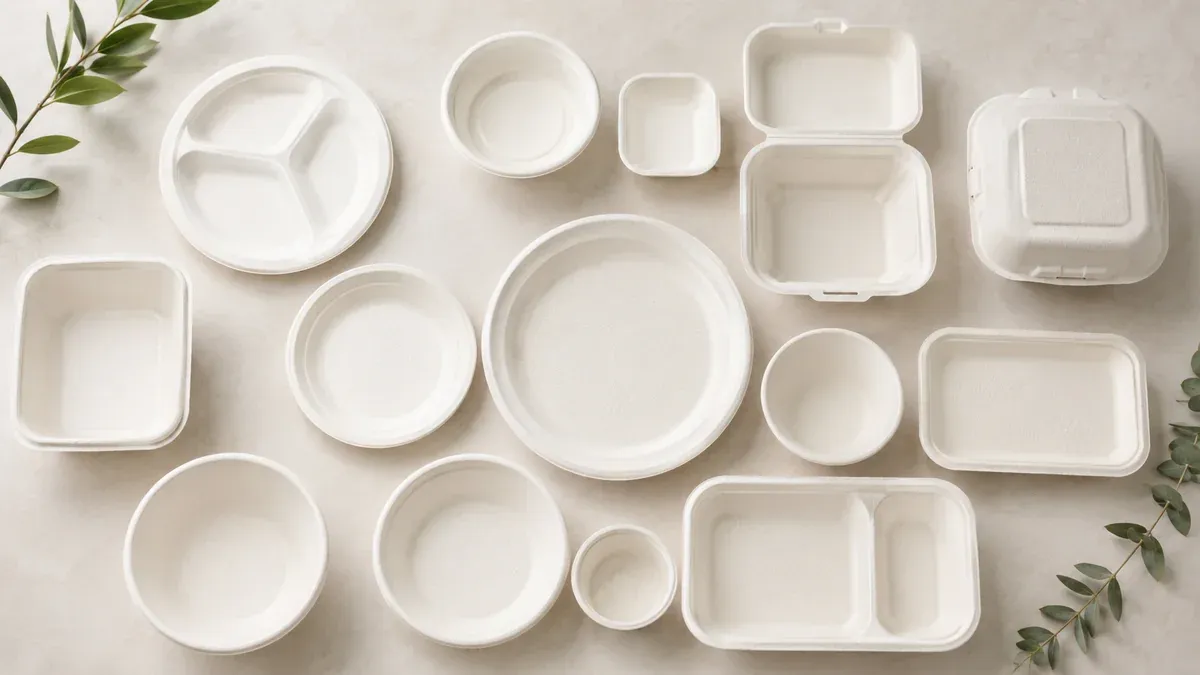
A sugarcane bagasse plate making machine is an industrial line that converts sugarcane bagasse fibre into molded compostable tableware: plates, bowls, trays and clamshell food containers. The technology family is called molded pulp or molded fibre manufacturing, and it has been used since the 1930s for egg cartons and packaging trays. Modern bagasse-specific machines emerged in the 2000s as a response to single-use plastic regulations and the growth of compostable food packaging.
Bagasse is the dry fibrous residue left after sugar mills crush sugarcane stalks to extract juice. India produces over 100 million tonnes of bagasse a year as a byproduct of its sugar industry, per FAO sugarcane production statistics and Indian Sugar Mills Association sugar production data. Brazil is the world's largest sugarcane producer, with India, China and Thailand following.
Important distinction: most buyers using the phrase "bagasse plate making machine" mean the plate-forming line (the equipment that turns wet pulp into finished plates). That line typically takes bagasse pulp sheet as its input, not raw bagasse. Starting from raw bagasse requires an additional pulping line upstream of the plate-forming machine. The two paths have different capex, footprint, and operating profile, covered in Section 3 below.
The output of either path is a 100% biodegradable, home-compostable plate that decomposes in 60 to 90 days at home-composting conditions (per BPI Certified Compostable standard and TUV Austria OK Compost Home certification).
2. Bagasse plate making machine manufacturers
Bagasse plate machines are supplied globally by a small number of dedicated molded-pulp specialists. The four names below are verified manufacturers active in bagasse / molded-fibre tableware machinery (companies that build and sell the machinery, not just consume it). The market is still consolidating, so this list is representative, not exhaustive.
Inclusion above is editorial reference only. WPM does not endorse any specific supplier. Always conduct independent technical and financial due diligence before procurement.
Featured directory supplier: Parason Machinery — India, manufacturer of molded-fibre and bagasse pulp-molding lines.
To request specification-matched quotes from verified suppliers, use our equipment inquiry form. To browse the full paper-machinery directory, see paper machinery suppliers.
Are you a bagasse machinery manufacturer or molded-pulp equipment supplier? List your business in our directory — free and verified tiers available. Bagasse and molded-pulp listings are currently underrepresented; early listers get prime visibility on this page and related buyer guides.
3. The two production paths: pulp sheet vs. raw bagasse
The same finished plate can be produced from two different starting points. The choice determines what equipment you need and how much capex the project requires.
Path A: Start from bagasse pulp sheet (most common for plate-makers)
Most small and mid-size plate manufacturers buy pre-made bagasse pulp sheet from a pulp mill, then repulp it and form plates. This path skips the heavy-equipment pulping line. Pulp sheets give uniform fibre quality, lower moisture, compact storage, and months of shelf life, which is why most plate-makers prefer this input.
Capex implication: the plate-forming machine alone (Path A) covers all the equipment above. Pricing in Section 6 of this guide refers to this scope.
Path B: Start from raw bagasse (integrated, larger operations)
Operations that want to control raw-material cost end-to-end source raw bagasse directly from sugar mills and add a pulping line upstream of the plate-forming machine. This is heavier engineering but lowers per-plate variable cost by 40 to 60% over the long term, since raw bagasse is roughly 30× cheaper per tonne than bagasse pulp sheet.
The pulping line adds 5 to 6 stages BEFORE the Path A stages above:
After stage P6, the pulp enters the Path A flow at Stage 4 (forming). The repulping stage (A2) is skipped because pulp is already in slurry form.
Capex implication: add roughly $50,000 to $300,000+ (₹48 lakh to ₹2.9 crore+) to the plate-line cost for the upstream pulping equipment, depending on capacity and whether bleaching is included. Indicative figures based on aggregated supplier disclosures and project-cost benchmarks for molded-pulp lines.
Which path is right?
Most new entrants start with Path A and migrate to Path B (or contract upstream pulping) once volume justifies the additional capex.
Path A buyers source ready bales of pulp sheet from verified bagasse pulp sheet manufacturers in India rather than building an in-house pulping line. The 7-supplier shortlist there, with molded fiber grade specs and current pricing, is the right reference before finalizing your machine spec.
4. Machine capacity tiers and throughput
Bagasse plate-forming machines are commonly classified by hourly output. Capacity should match local demand, pulp-sheet (or bagasse) supply, and operating-cost economics.
Output ranges based on aggregated supplier specification sheets and trade-publication benchmarks. Capacity scales non-linearly with cost: doubling output rarely doubles the price because larger machines amortize the same control system and footprint across more output.
5. Manual vs. semi-automatic vs. fully automatic
Automation level is the single largest driver of both machine price and labour cost. Choose based on labour-cost geography and expected production volume.
Price ranges based on aggregated public supplier disclosures and project-cost benchmarks for molded-pulp lines. A typical scale-up path is manual to semi-automatic at around 2 to 3 million plates per year, and semi-automatic to fully automatic at 8 to 12 million plates per year. Skipping the semi-automatic step is rare because it lets the team learn process control before committing larger capital.
6. Cost by capacity (Path A: plate machine only)
The numbers below are indicative ranges for the plate-forming machine only (Path A: starting from bagasse pulp sheet). Costs are not quotes. Final pricing depends on automation level, country of manufacture, mould count per machine, optional accessories (coating station, automated stacker), and currency at order time. Conversion at ₹96.28/USD per Google Finance / Morningstar 18 May 2026 rate.
Pricing disclaimer: All figures are indicative ranges aggregated from publicly available 2024 to 2026 supplier disclosures, regional dealer quotes, and project-cost benchmarks for molded-pulp lines. Actual pricing varies materially by configuration, mould count, automation depth, country of origin, freight, import duties and currency. Confirm via a custom quote before any commitment.
Currency Conversion Reference (approx 2026-05 spot rates per 1 USD; verify before transactions):
Rates indicative; use the prevailing spot rate at order time.
Path B add-on: pulping line capex (only if starting from raw bagasse)
If you choose Path B (raw bagasse), add the following to the plate-machine cost:
Pulping-line equipment ranges aggregated from supplier disclosures and project-cost benchmarks for molded-pulp lines.
Common capex items not in the machine quote
Total project cost typically runs 1.5 to 2× the machine-only price for Path A, and 1.6 to 2.2× for Path B after adding civil, utilities, accessories and working capital.
7. ROI and payback math
Payback is driven by three variables: raw-material cost (pulp sheet or raw bagasse), finished-plate selling price, and capacity utilization. Indicative ROI for a mid-size semi-automatic line is shown below.
These figures assume domestic-market sales at standard pricing. Export-grade plates with FDA / EU food-contact certification can sell at 40 to 60% premium, shortening payback to 10 to 14 months but requiring upfront certification investment of $15,000 to $30,000 (₹14.4 lakh to ₹28.8 lakh).
8. Raw material economics
This section covers BOTH paths (pulp sheet for Path A, raw bagasse for Path B).
Bagasse pulp sheet pricing (Path A input)
A standard 8-inch bagasse plate uses around 12 to 15 grams of dry pulp (industry-typical molded-pulp formation specification). One tonne of pulp sheet therefore produces approximately 65,000 to 80,000 plates. At ₹85,000/tonne (mid-range pulp sheet price), pulp-sheet raw-material cost is approximately ₹1.06 to ₹1.31 per plate (~$0.011 to $0.014). This is 5 to 10% of the finished retail price.
Raw bagasse pricing (Path B input)
Raw bagasse at ₹3,500/tonne (mid-range Indian price) yields a per-plate raw-fibre cost of approximately ₹0.044 to ₹0.054 ($0.0005 to $0.0006) per plate, roughly 25× cheaper than starting from pulp sheet. This raw-material advantage is the structural reason large operations invest in their own pulping line (Path B).
For raw-material context across the paper industry, see essential raw materials for paper manufacturing.
9. Bagasse plates vs. other compostable materials
Bagasse competes against several alternative compostable materials for the disposable tableware market. The comparison below shows where each material wins.
Per-plate retail prices aggregated from public retail and B2B distributor listings across India, US and EU markets.
Bagasse wins on: Low raw-material cost, high heat tolerance (suitable for hot food), abundant supply, home-compostability without industrial-facility requirement.
Bagasse loses to palm leaf on: Premium aesthetics for wedding and event catering.
Bagasse loses to paper on: Lowest absolute cost (for non-food-contact applications).
10. Regulatory tailwinds: single-use plastic bans
The compostable tableware market is driven primarily by regulation, not consumer preference. Major plastic bans implemented between 2021 and 2025 have created mandatory demand for alternatives.
The Indian compostable tableware market is estimated to exceed $1.5 billion by 2026 (estimate derived from FICCI compostable packaging industry reports and category extrapolation). Global market estimates from research firms suggest a $25 billion addressable market by 2028, though sources vary.
11. New vs. refurbished machines
A small but growing share of small mills (under 1,500 plates/hour) is built using refurbished molded-pulp machines, mostly from decommissioned European egg-tray and food-packaging lines.
A 1990s-to-2000s era moulded-pulp line in good condition can typically be acquired and rebuilt for 40 to 60% of new-machine cost, with a rebuild timeline of 4 to 8 months. The trade-off is older controls, lower automation, and higher energy use per plate, which can erase the capex saving over a 5-year operating life.
Reputable used-equipment brokers in North America and Europe handle most of this market. Inspection by an experienced consultant before signing is essential. The two most common failure points on old molded-pulp lines are corroded vacuum systems and worn hot-press platens, both expensive to replace.
12. Buyer's evaluation checklist
Before signing any quote, evaluate suppliers against the following 10-point checklist:
- Reference projects. Has the supplier shipped at least 5 lines in the last 24 months at your target capacity tier?
- Path A or Path B scope. Does the quote include the upstream pulping line (Path B) or only the plate-forming machine (Path A)? Confirm in writing.
- Bagasse-specific tooling. Are the moulds and pulp recipe specifically tuned for bagasse, or is it a generic molded-pulp machine being re-purposed?
- Lead time. Indian / Chinese suppliers typically quote 60 to 120 days; European 120 to 180 days. Factor in shipping and customs.
- Aftermarket spare parts. Critical wear parts (moulds, vacuum-pump seals, doctor blades) should have local stock or 7-to-10-day air-freight availability.
- Operator training. Most reputable suppliers include 1-week on-site commissioning and operator training; confirm in writing.
- Output certification. If selling to export markets, verify FDA / EU food-contact compliance, BIS / IS conformity (India), and home-compostability certification (BPI in the US, TUV Austria OK Compost Home in Europe).
- Energy consumption. Ask for the specific energy consumption in kWh per 1,000 plates; modern lines should be under 6 kWh per 1,000 plates.
- Mould count and changeover time. More moulds per cycle = higher output; mould changeover for shape variants (plate / bowl / tray) should be under 2 hours.
- Payment terms and warranty. Standard is 30% advance, 60% before shipment, 10% after commissioning. Typical warranties run 12 to 24 months on the machine and 6 months on consumables.
13. Further Reading & Industry Resources
- Bagasse tableware market & strategy: Sugarcane bagasse tableware products market · Disposable tableware market · Disposable tableware manufacturing
- Bagasse plant setup: Start a bagasse product manufacturing plant
- Raw material context: Essential raw materials for paper and pulp
- Suppliers: Paper mill machine manufacturers directory · Equipment inquiry · List your business
External references: - FAO sugarcane data (FAOSTAT) - ISMA India sugar statistics - Indian Ministry of Environment SUP guidelines - EU Single-Use Plastics Directive - BPI Certified Compostable standard - TUV Austria OK Compost Home certification


